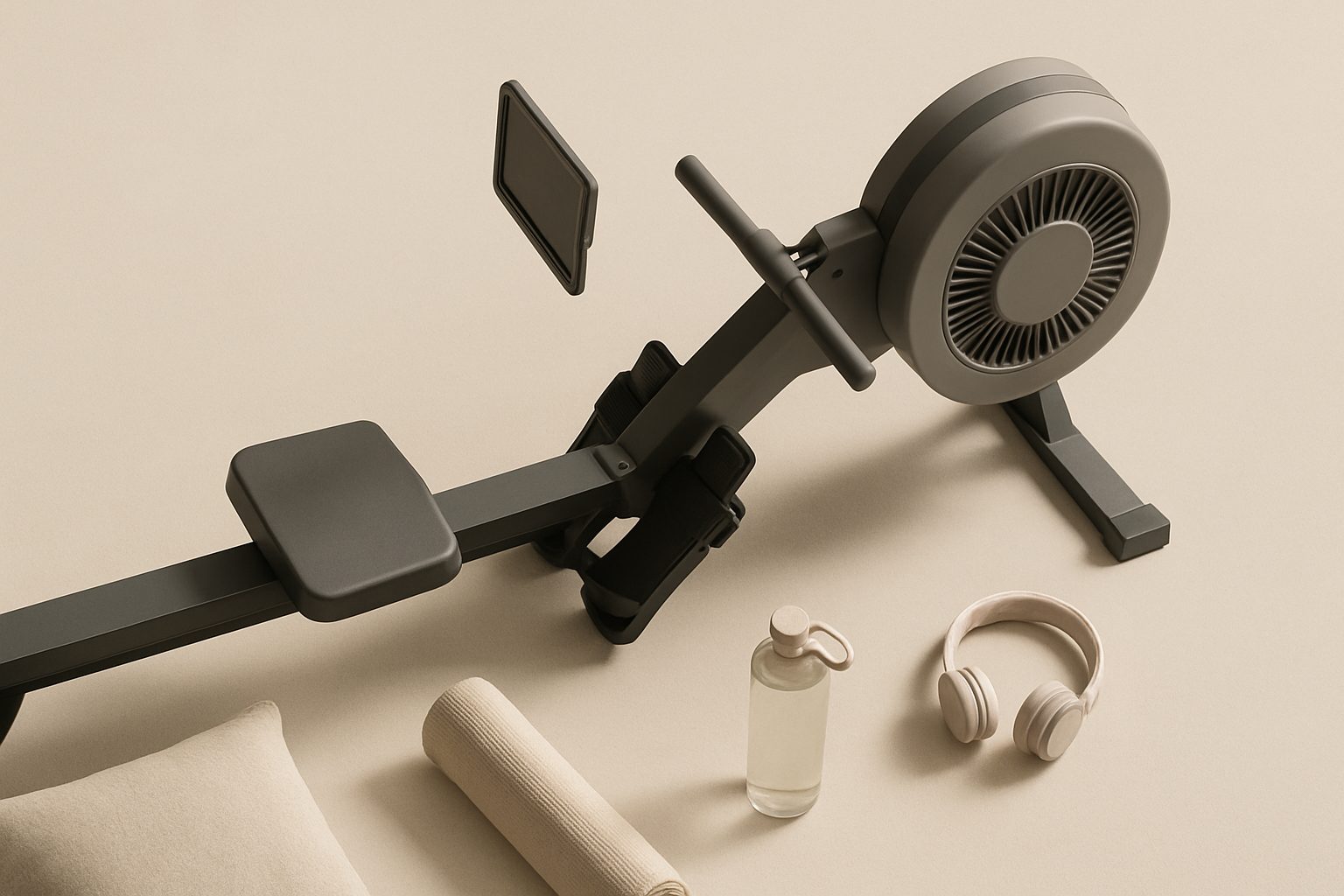
Rowing Machine vs Exercise Bike UK: Which Is Better for Home Cardio?
Choosing between a rowing machine and an exercise bike often comes down to what you actually want from your cardio. Both deliver solid cardiovascular benefits and fit most home spaces, but they work your body very differently. The "better" choice depends on your fitness goals, joint health, and what you're prepared to commit to.
Muscle Engagement
This is where the two equipment types diverge most clearly.
An exercise bike is primarily a lower-body tool. You're working your quads, glutes, hamstrings, and calves. Your upper body sits idle. If leg strength and lower-body endurance are your main focus, that's fine—a bike does that job efficiently. Stationary bikes are also genuinely safer for beginners because the movement pattern is intuitive and hard to get wrong.
A rowing machine engages roughly 85% of your body's muscles in a single session. You're using your legs, core, back, shoulders, and arms. Every stroke involves a coordinated pull that builds functional strength across multiple muscle groups. This fuller-body engagement means you'll burn calories more effectively and build lean muscle more comprehensively—which matters if you're doing cardio to improve general fitness rather than just leg endurance.
The trade-off is learning curve. Rowing has a technique; cycling doesn't. A rowing machine rewards good form and punishes poor technique with back discomfort or inefficiency. Most people need 3–5 sessions to feel confident on a rower.
Calorie Burn
Both equipment types can deliver serious calorie expenditure. The figures vary wildly by intensity and bodyweight, but here's the realistic picture.
A 75kg person on a stationary bike, working at moderate intensity, burns roughly 400–500 calories per hour. Push harder (high resistance, higher cadence), and that climbs toward 600–700.
The same person on a rowing machine burns approximately 500–700 calories per hour at moderate intensity, with serious effort reaching 800+. Rowing edges ahead because it involves more muscle mass. More muscle working = more energy expenditure.
That said, the difference shrinks if you're not comparing like with like. Someone doing a relaxed, low-resistance bike session will burn fewer calories than someone attacking a rowing machine hard. Intensity matters more than equipment type.
Joint Impact and Comfort
Exercise bikes are joint-friendly. They're low-impact, seated, and rhythmic. If you have knee problems, back issues, or arthritis, a bike is the safer starting point. The pedalling motion is smooth and doesn't jar your joints.
Rowing machines are also low-impact—there's no running or jumping—but they're not impact-free. The rowing motion involves a stretch at the catch (the beginning of the stroke) which can aggravate tight hamstrings or a sensitive lower back if you're not careful. Proper technique and gradual progression are essential.
For people with existing joint complaints, a bike is the lower-risk option. But for those with healthy joints who want to strengthen their back and core, rowing often feels more therapeutic than punishing. Many people find rowing genuinely satisfying; fewer say the same about a stationary bike.
Space and Practicality
An exercise bike occupies roughly 1m × 0.5m of floor space. It's compact, and most designs don't look out of place in a living room. You can fold some models, though folding quality varies wildly—cheap folding bikes are often wobbly when unfolded.
A rowing machine is longer: typically 2m × 0.6m. It's thinner than a bike, but you need proper length. It also has a rowing slide that can squeak or rattle if it's poorly made or poorly maintained. The footprint is a genuine consideration for small homes.
If you're in a flat with limited space, a bike wins. If you have a spare bedroom or a basement, rowing is manageable.
Price and Value
Budget stationary bikes start around £200–300 and go up to £800 for decent mid-range models with smooth resistance and stable frames. Premium smart bikes (Peloton rivals, Wattbike) cost £1,500+.
Entry-level rowing machines typically cost £300–500. Mid-range, reliable models sit at £600–1,000. Premium water rowers push past £1,500. Budget rowers can be noisy and feel flimsy; good ones feel solid and are quiet enough for a flat.
For the money, you often get better value from a rowing machine—a £600 rower will last years and build real fitness. A £600 bike is fine, but so is a £400 one. There's less quality variance in the mid-range for rowing.
The Verdict
Choose an exercise bike if:
- Your knees or lower back are already painful
- You want a dead-simple, low-barrier-to-entry cardio tool
- You have very limited space
- You're focused purely on leg strength and endurance
Choose a rowing machine if:
- You want full-body muscle engagement and calorie efficiency
- You have moderate space
- You're willing to spend a few sessions learning decent technique
- You value variety and the challenge of coordinated movement
For most people seeking comprehensive home fitness, a rowing machine delivers more return on effort and investment. But an exercise bike is the smarter starting point if you have joint concerns or need something immediately intuitive. There's no wrong choice—only the one that matches your goals and body.
More options
- Concept2 RowErg Indoor Rowing Machine (Amazon UK)
- WaterRower Natural Rowing Machine (Ash Wood) (Amazon UK)
- Bluefin Fitness Sprint 2.0 Magnetic Rowing Machine (Amazon UK)
- JLL R200 Home Rowing Machine (Amazon UK)
- Jorvik Tri-Mode Water Rowing Machine (Amazon UK)