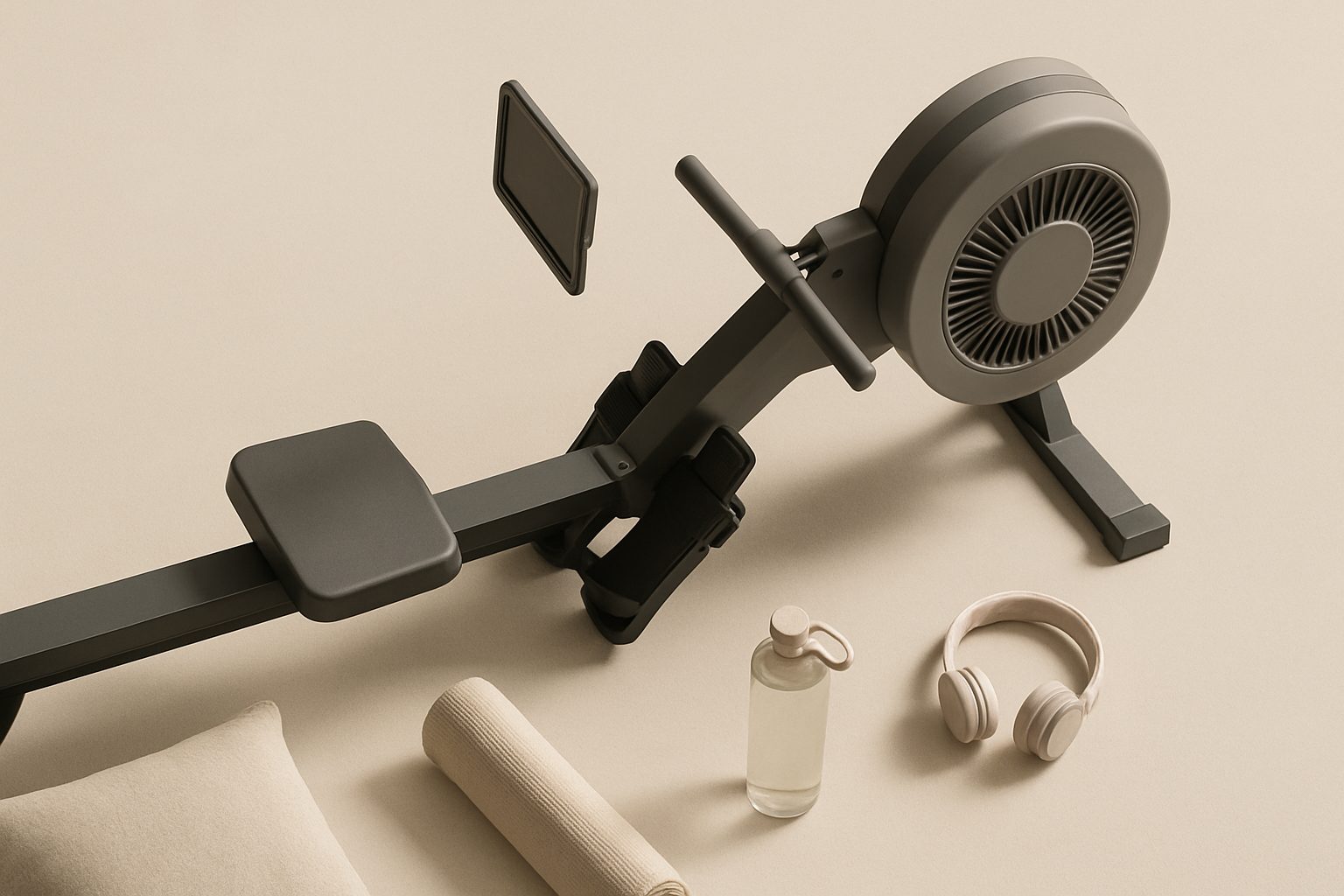
What Muscles Does a Rowing Machine Work? Full Body Breakdown for UK Buyers
If you think rowing machines are just an arm exercise, you're missing what makes them one of the most effective full-body fitness tools available. Most people assume you're pulling with your arms, but the reality is quite different. A proper rowing stroke is roughly 60% legs, 20% core, and 20% upper body—and understanding this breakdown matters when you're deciding whether a rowing machine is right for your home gym.
The Rowing Stroke: How It Actually Works
The confusion around rowing muscles often comes down to how people approach the machine. A lot of beginners start by pulling with their arms, which is inefficient and exhausting. The correct sequence—which any decent rowing machine encourages through its resistance system—is legs first, then core, then arms. This isn't just about technique; it's about where your body's largest muscle groups can generate power.
When you slide forward on the seat, your legs are compressed. When you drive back, you're extending your legs against the resistance—and that's where roughly 60% of your effort goes. Your core stabilises the movement and transfers force from your legs to your upper body. Your arms finish the stroke by bringing the handle to your chest. The order matters because it distributes the work efficiently.
Legs: The Engine Room
Your legs do the heavy lifting on a rowing machine. The primary muscles working are:
- Quadriceps – these drive the initial push-back phase and bear the most load
- Glutes – they work alongside the quads to extend your hips powerfully
- Hamstrings – they assist the glutes and help stabilise the movement
- Calves – they engage during the leg drive, particularly as you complete the extension
Unlike a stationary bike, where you're pedalling in a fixed plane, rowing involves a longer range of motion. You're pushing your entire bodyweight back against resistance, which taxes your legs significantly. This is why a 30-minute row can leave your legs genuinely fatigued, especially if you're new to it.
For UK buyers concerned about whether a rowing machine will build leg strength, the answer is yes—but it's more about muscular endurance and power than isolated strength gains. If your goal is serious leg muscle growth, adding squats or a leg press remains worthwhile. However, for functional leg strength and cardiovascular fitness combined, rowing is hard to beat.
Core: The Critical Stabiliser
Your core—including your rectus abdominis (six-pack muscles), obliques, and deep transverse abdominis—works throughout the entire stroke. During the leg drive, your core prevents your torso from collapsing forward. During the pull, it stabilises your spine under load. During the recovery, it controls your return to the starting position.
This is why rowing machines are excellent for core strength without being a dedicated core workout. You're not doing crunches or planks; you're maintaining spinal stability under dynamic load. It's functional, practical core work that carries over to daily activities and other sports.
Many people don't feel their core "burning" on a rowing machine because the fatigue is distributed across your entire body. But that doesn't mean it's not working—it's working constantly, just not in isolation.
Upper Body: The Finisher
Your upper body—comprising your lats, rhomboids, rear delts, biceps, and forearms—completes the pull. This is where a lot of the confusion comes from. Your arms aren't doing the pulling; they're finishing it. Your lats (the large muscles on the sides of your back) are the primary movers here, pulling your elbows back and down. Your biceps assist, but they're not the main event.
If you were to row using only your arms, you'd fatigue quickly and miss the power generated by your legs and core. A properly executed rowing stroke feels almost effortless for the upper body because the heavy work is already done.
This means a rowing machine won't build massive arm muscles like isolation exercises would, but it does contribute to back development, particularly the lats and rhomboids. For a balanced upper-body workout, you'd supplement rowing with dedicated pushing exercises like press-ups or a bench press.
Why This Matters for Your Training
Understanding the muscle-group breakdown changes how you approach rowing training. If you're trying to improve your cardiovascular fitness and burn calories, rowing is superb—you're engaging your largest muscle groups. If you're looking to build specific muscles, rowing works best as part of a broader strength programme rather than as your only tool.
The full-body nature of rowing also means it's time-efficient. A 20-minute session works more muscles than 20 minutes of isolation exercises, which appeals to people with limited time for home workouts.
Getting Started
Knowing which muscles work is one thing; using that knowledge effectively is another. Beginners typically benefit from learning proper technique first—focusing on the leg-drive-first sequence—before worrying about intensity. A slow, controlled stroke at a lower resistance teaches your body the correct movement pattern.
For detailed guidance on starting with a rowing machine as a complete beginner, explore beginner-specific rowing techniques and how to structure your first few weeks. You'll also find dedicated workout plans that progressively build your fitness using a rower.
The myth that rowing machines are just an arm workout dies once you've done a few sessions properly. Your legs will tell you exactly where the real work is happening.
More options
- Concept2 RowErg Indoor Rowing Machine (Amazon UK)
- WaterRower Natural Rowing Machine (Ash Wood) (Amazon UK)
- Bluefin Fitness Sprint 2.0 Magnetic Rowing Machine (Amazon UK)
- JLL R200 Home Rowing Machine (Amazon UK)
- Jorvik Tri-Mode Water Rowing Machine (Amazon UK)